Virtual assets
Exchanges, fiat-to-crypto ramps, OTC desks and virtual asset custodians.
API-first AML infrastructure for virtual assets after the 2025 reform: mandatory identification in every transaction, real-time aggregation for the new 210 UMA ($24,635.10 MXN) reporting threshold, Automated 8-source screening and 24-hour cases.
- Legal basis
- Art. 17, section XVI
- Identification threshold
- Always (every transaction)
- Reporting threshold
- 210 UMA ($24,635 MXN)
- LFPIORPI Reform (Sect. XVI)
- Identification always · Report from 210 UMA

INTERACTIVE REGULATORY COCKPIT
Simulate AML Compliance for Your Industry
Calculated in real-time with official 2026 UMA ($117.31 MXN), Art. 17 notification thresholds and Art. 32 cash restrictions.
Art. 17 LFPIORPI
Identification on all operations; SAT XML report at 8,025 UMA and strict Art. 32 cash cap.
8,025 UMA ($941,412 MXN)
Identification threshold: Always (every deed/contract)
8,025 UMA ($941,412 MXN)
Exceeding this limit in cash constitutes a serious sanction under Art. 53.
Anexo 5
Cumulative 6-month threshold monitoring per client
CAPABILITIES FOR YOUR INDUSTRY
How PLDUnity helps
- 01Feature
New Section XVI threshold: Identification always & report from 210 UMA
Following the 2025 LFPIORPI reform, every transaction requires identification and reporting starts at 210 UMA ($24,635.10 MXN at 2026 UMA). PLDUnity handles that volume automatically.
- 02Feature
High-volume REST API with idempotency & HMAC-SHA256 webhooks
Stream buys, sells, swaps, deposits and withdrawals as they happen on your platform; receive signed webhook notifications for alerts and risk changes in real time.
- 03Feature
Remote KYC onboarding with AI extraction & AI-assisted facial comparison (not certified biometrics)
Embed link-based verification for retail users and institutional OTC clients: ID/Passport, verified selfie, tax certificate and Beneficial Owner records.
- 04Feature
Automated 8-source screening across your entire active user base
Screens active users individually or in batches against OFAC, UN, OFSI, FBI, PEP and SAT 69-B, automatically opening a 24-hour unusual activity case on critical matches.
- 05Feature
2027 EBR risk engine recalculated monthly
Scores every user's risk grade on the 2nd of each month based on virtual asset volume, velocity, jurisdiction and screening outcomes.
- 06Feature
Bulk Section XVI XML generation validated against the SAT XSD
Consolidates thousands of reportable monthly transactions with official virtual asset catalog codes and exchange rates, validating the XML before the 17th and retaining evidence for 10 years.
END-TO-END WORKFLOW
How PLDUnity runs end-to-end in your industry
A single connected workflow for buying, selling, swapping, custody and transfer of virtual assets—without re-keying data between spreadsheets and separate tools.
- 01KYC & Beneficial Owner
Identify every user, trader or institutional client
Embed remote verification into your onboarding flow: users upload their ID/Passport, selfie with AI-assisted facial comparison and tax certificate; AI extracts fields and an analyst confirms before enabling withdrawals or trading.
- 02UMA & Art. 32 Engine
Capture, aggregate & check cash caps
Stream transactions in real time from your exchange, fiat-to-crypto ramp or OTC desk via our REST API. The engine converts amounts to MXN, aggregates per user across 6-month windows and automatically flags anyone crossing 210 UMA ($24,635.10 MXN).
- 037 List Sources + EBR 2027
Watchlist screening & EBR risk grade
Screen your user base individually or in batches against 7 official list sources (UN, OFAC, OFSI, FBI, SAT 69-B, Unlocated, PEP), trigger 24-hour clocks on unusual activity and recalculate EBR risk scores.
- 04SAT XSD + 10-Yr Vault
Validated XML report & SHA-256 evidence
Generate the Section XVI XML consolidating thousands of transactions, official virtual asset catalog codes and MXN equivalents, validated against the SAT XSD before the 17th.
MEASURABLE IMPACT
Tangible value for every area of your company
PLDUnity removes friction from commercial operations while giving your Compliance Officer and Board verifiable certainty.
Built for fintech and crypto scale via API
With the reporting threshold lowered to 210 UMA ($24,635.10 MXN) after the 2025 reform, exchanges and ramps cannot rely on spreadsheets. Our API ingests transactions in real time and sends HMAC-SHA256 signed webhooks.
From days of spreadsheet work to minutes before the 17th
Unify threshold monitoring, 24-hour unusual transaction cases, user-base screening and EBR risk scoring in a single console.
Protection against fines up to 65,000 UMA ($7.6M MXN)
Show the SAT, UIF and your banking/SPEI partners an institutional-grade compliance program running on Google Cloud with an immutable server-written audit log.
WHY CHOOSE PLDUNITY
The PLDUnity differentiator
Built in Mexico by BDUnity®, an AML compliance consultancy advising reporting entities since 2012.
Tailored to your exact Article 17 fraction
API-first architecture with idempotency, HMAC-SHA256 signed webhooks, native SAT Virtual Assets XSD validation and 6-month accumulation tracking built for the 210 UMA threshold.
Software with real consultants behind it
Created by BDUnity® (active since 2012). Every validation rule, annex checklist and audit package reflects real SAT inspections—not generic template software.
AI that accelerates, an Officer who decides
AI reads IDs, tax certificates and custom Excel columns in seconds, but every critical match, risk methodology and XML filing is confirmed by your Compliance Officer.
Google Cloud isolation & SHA-256 fingerprints
Each company runs isolated with TOTP 2FA, role-based segregation of duties, a server-only audit log and SHA-256 hashes on every XML, acknowledgment and 10-year export.
BEFORE & AFTER
Manual spreadsheets vs. PLDUnity in your industry
Why reporting entities replace disconnected folders and generic tools with a purpose-built LFPIORPI platform.
| Compliance dimension | Spreadsheets & disconnected tools | With PLDUnity® in your industry |
|---|---|---|
| 6-month UMA aggregation & thresholds | With the new 210 UMA ($24,635 MXN) threshold, hundreds or thousands of users cross into reportable territory each month, making manual XML prep impossible. | Continuous API ingestion and automated generation of the Section XVI XML validated against the official SAT XSD at any transaction volume. |
| Client KYC & watchlist screening | Screening a user only on the day they signed up and missing when they later appear on OFAC, UN or SAT 69-B lists. | Per-user and batch screening of your active user base across 7 official list sources, opening a 24-hour case on critical matches. |
| Monthly SAT XML preparation | Manual XML capture prone to schema errors, malformed RFCs/CURPs and last-minute rejections on the 17th. | Pre-validated against the official SAT XSD schema for your activity, plus one-click nil reports and linked acknowledgments. |
| 2027 Risk-Based Assessment (EBR) | Static Word document without individual client risk recalculation or historical audit trail. | Four-factor EBR engine with capped mitigants that recalculates every client's risk grade on the 2nd of each month. |
| SAT / UIF inspection readiness | Weeks spent gathering scattered PDFs, emails and acknowledgments across former employees' computers. | One-click audit package with server-written logs, SHA-256 integrity hashes and expiring read-only access for external auditors. |
ALL-IN-ONE PLATFORM
All 8 platform modules working together for Virtual assets
Your subscription includes the complete AML compliance suite—no hidden add-ons per module.
Transaction Upload (Excel, AI & API)
Validate every record against SAT catalogs with idempotency and 6-month accumulation.
UMA Threshold Monitoring
Automatic tracking of identification, reporting and Art. 32 cash caps in current UMA.
Digital Customer Files & Remote KYC
Remote link or QR with AI document reading (OCR), AI-assisted face match, and liveness test.
7-Source Watchlist Screening
UN, OFAC (SDN & consolidated), UK (OFSI), FBI, SAT 69-B, Non-Located & PEP queried per client, in batches, or manually.
2027 Risk-Based Assessment (EBR)
Four-factor risk methodology and per-client risk grade recalculated every month.
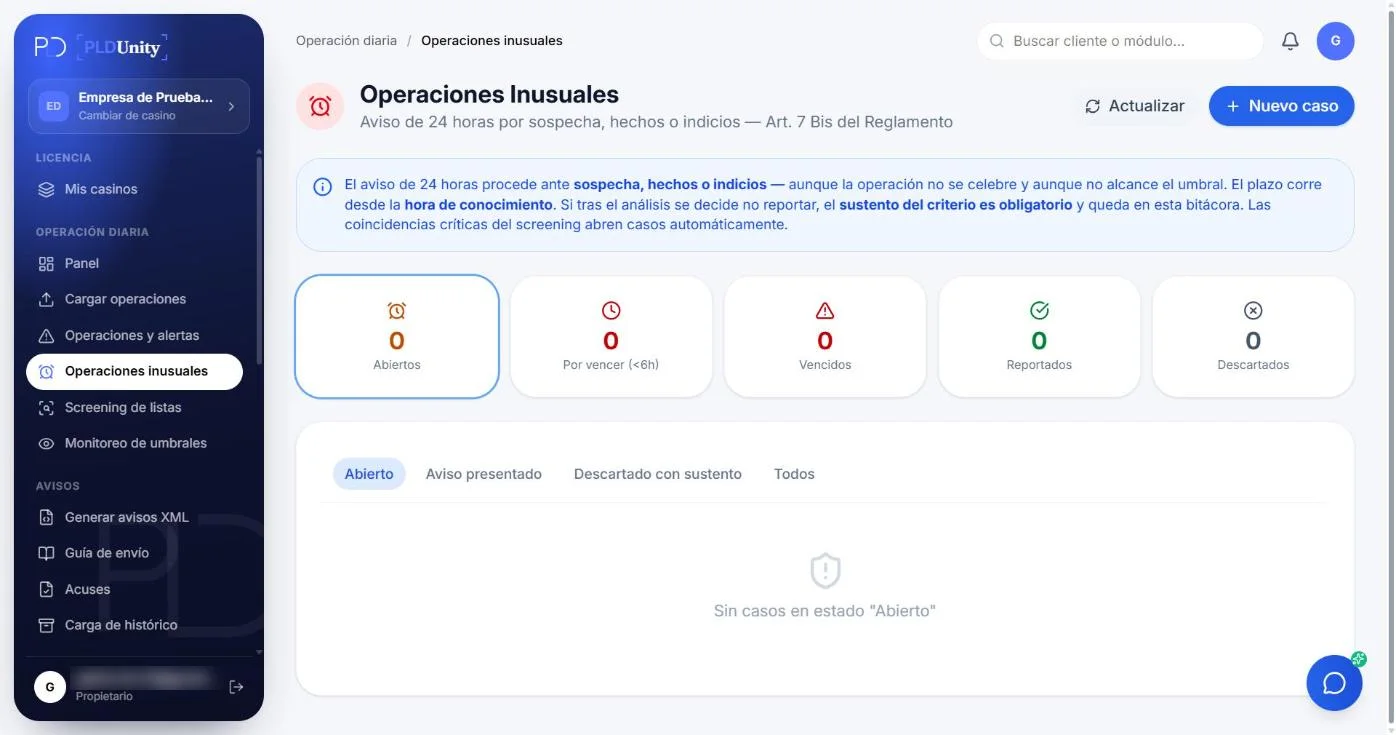
24-Hour Unusual Transactions
Automated case clock, red-flag analysis and documented Compliance Officer decisions.
SAT XML Generator (19 XSDs)
Pre-validated XML for your exact Article 17 fraction, one-click nil reports and acknowledgments.
10-Year SHA-256 Audit & Training
Immutable server log, 16-obligation self-assessment, AML courses and portable audit packages.
REGULATORY & OPERATIONAL GUIDE
Compliance Guidelines for Virtual assets
Essential LFPIORPI obligations, identification criteria, and supervisory rules applicable to this activity.
Why the new 210 UMA threshold makes API automation mandatory for virtual assets
With the July 16, 2025 LFPIORPI reform, Section XVI (virtual asset transactions) lowered its reporting threshold to just 210 UMA ($24,635.10 MXN at the 2026 UMA of $117.31) and made client identification mandatory in every single transaction. For an exchange, payment ramp or OTC desk, a large share of active monthly users now enters the SAT XML report.
Attempting to consolidate thousands of crypto buys, sells, swaps and transfers in manual spreadsheets is operationally impossible and creates severe risk of XSD schema rejections or missed 24-hour unusual transaction deadlines.
Institutional-grade AML compliance on Google Cloud for your crypto platform
PLDUnity connects via REST API to your transactional backend: it ingests every trade with idempotency keys, aggregates MXN totals per user across rolling 6-month windows, runs per-client and batch screening against 7 official watchlist sources and generates the Section XVI XML ready for the SAT portal, backed by an immutable server log and SHA-256 hashes.
FREQUENTLY ASKED QUESTIONS
Frequently asked questions
Does the 210 UMA threshold apply per single trade or per user accumulation?
It applies both when a single transaction reaches or exceeds 210 UMA ($24,635.10 MXN in 2026) and when the sum of a user's transactions over a rolling 6-month window reaches that amount.
How does PLDUnity integrate with our exchange or OTC backend?
Through our documented REST API: stream user onboardings and transactions in real time with idempotency keys and receive HMAC-SHA256 signed webhooks whenever an alert triggers or a KYC status changes.
What happens if an existing user appears months later on an OFAC or SAT 69-B list?
Batch and per-client screening checks your active user base against all 7 weekly-updated watchlist sources. A critical match automatically opens a 24-hour unusual transaction case for your Compliance Officer.
Does it support institutional OTC clients (legal entities) as well as retail users?
Yes. Alongside fast retail KYC, the KYC Vault manages full domestic and foreign corporate files, including incorporation deeds, powers of attorney and Beneficial Owner structures.
What does the 210 UMA threshold equal in MXN for 2026 under Section XVI (Virtual Assets)?
With the 2026 daily UMA of $117.31 MXN, the 210 UMA notice threshold for virtual asset exchange, custody, or transfer equals $24,635.10 MXN (either in a single trade or accumulated across a rolling 6-month window per user). Full KYC onboarding is required for every user from their first account registration.
Which crypto-specific fields are validated before generating the official Annex 16 SAT XML?
The XML engine validates all mandatory Annex 16 nodes: virtual asset identifier/catalog code, unit quantity and decimal precision, MXN exchange value at execution timestamp, transaction reference, and complete KYC and 25% Beneficial Owner records.
How does PLDUnity cover automated monitoring and 24-hour notices ahead of the June 2027 deadline?
PLDUnity ingests trades via REST API, runs daily sweeps across all 7 watchlists (including OFAC SDN and UIF), updates user EBR risk scores dynamically, and detects structuring just below 210 UMA—enabling auditable 24-hour notices.
30-DAY FREE TRIAL · NO CREDIT CARD
Ready to automate AML compliance for Virtual assets?
Start your 30-day free trial with your own transactions or schedule a 30-minute walkthrough with BDUnity's compliance specialists.