Precious metals, stones and jewelry
Jewelers, fine watch boutiques, diamonds and precious metals dealers.
Discreet, precise compliance for jewelry and watch retailers: digital in-boutique KYC from 805 UMA, repeat-purchase aggregation for reporting from 1,605 UMA and strict enforcement of the 3,210 UMA cash ban.
- Legal basis
- Art. 17, section VI
- Identification threshold
- 805 UMA ($94,434 MXN)
- Reporting threshold
- 1,605 UMA ($188,282 MXN)
- Cash ban (Art. 32)
- 3,210 UMA ($376,565.10 MXN)

INTERACTIVE REGULATORY COCKPIT
Simulate AML Compliance for Your Industry
Calculated in real-time with official 2026 UMA ($117.31 MXN), Art. 17 notification thresholds and Art. 32 cash restrictions.
Art. 17 LFPIORPI
Identification on all operations; SAT XML report at 8,025 UMA and strict Art. 32 cash cap.
8,025 UMA ($941,412 MXN)
Identification threshold: Always (every deed/contract)
8,025 UMA ($941,412 MXN)
Exceeding this limit in cash constitutes a serious sanction under Art. 53.
Anexo 5
Cumulative 6-month threshold monitoring per client
CAPABILITIES FOR YOUR INDUSTRY
How PLDUnity helps
- 01Feature
Section VI thresholds (805 & 1,605 UMA)
Identifies single sales or accumulated clients from $94,434.55 MXN (805 UMA) and triggers SAT reporting from $188,282.55 MXN (1,605 UMA).
- 02Feature
6-month accumulation across boutiques and sales channels
Catches repeat buyers making multiple mid-ticket purchases (e.g., three $70,000 MXN pieces across different months or stores) by summing their rolling 6-month total.
- 03Feature
VIP KYC verification on the client's smartphone
No photocopies or paper forms at the counter: the client opens a private link, uploads their ID or passport and AI builds the file in 90 seconds.
- 04Feature
Article 32 cash cap lock above 3,210 UMA
Automatically ensures no watch, jewelry or precious metal sale is settled in cash at or above $376,565.10 MXN (3,210 UMA).
- 05Feature
Automated 8-source screening & structuring alerts
Screens domestic and foreign buyers against OFAC, UN, PEP, SAT 69-B, FBI and OFSI and opens 24-hour cases on unusual split-purchase patterns.
- 06Feature
Section VI XML with official SAT item catalogs
Classifies precious metals, stones, jewelry or watches using official SAT catalog codes, validates the XML against the XSD before the 17th and retains records for 10 years.
END-TO-END WORKFLOW
How PLDUnity runs end-to-end in your industry
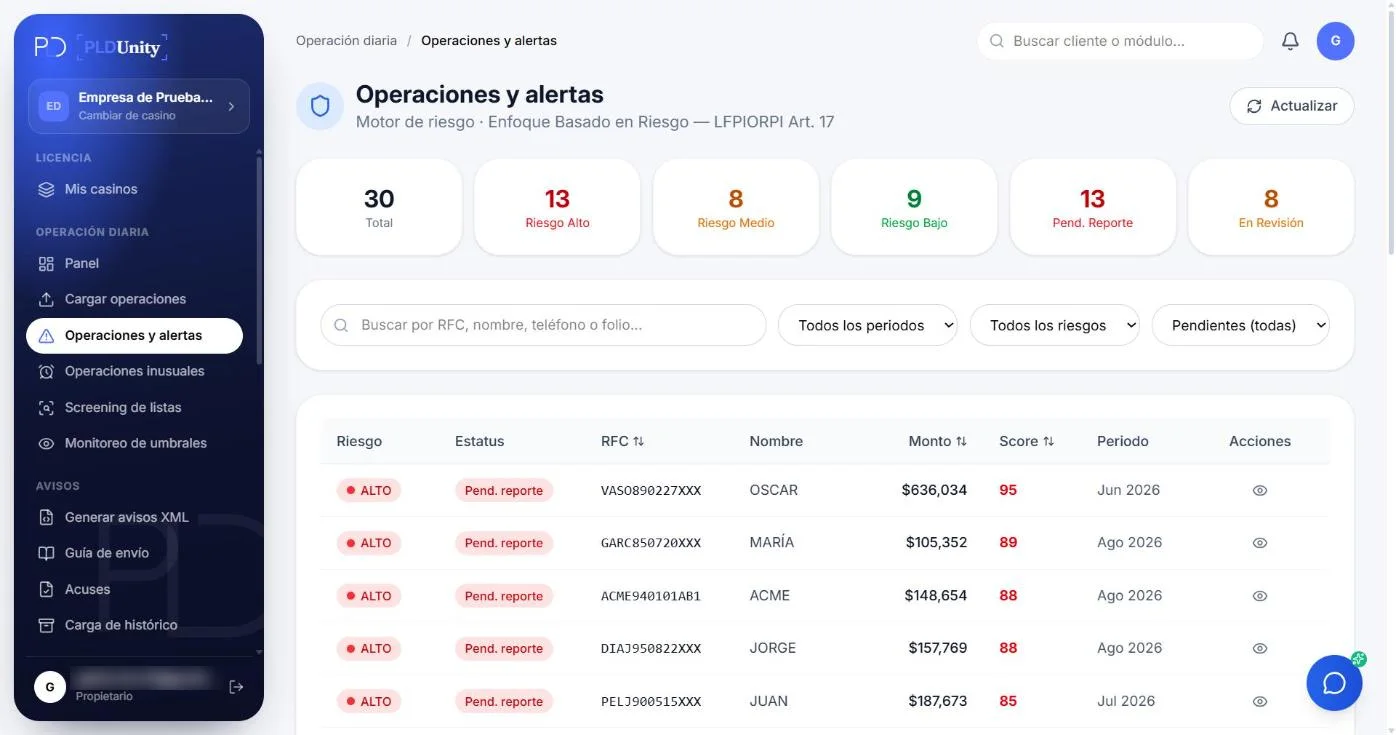
A single connected workflow for sales of fine watches, jewelry, diamonds and precious metals—without re-keying data between spreadsheets and separate tools.
- 01KYC & Beneficial Owner
Identify every buyer or collector
For purchases from 805 UMA ($94,434.55 MXN)—or when a repeat client approaches that amount—send a discreet link to the client's phone in the boutique to capture their ID/Passport and tax certificate with AI.
- 02UMA & Art. 32 Engine
Capture, aggregate & check cash caps
Sync sales from your POS or ERP via file or API. PLDUnity sums every piece purchased by the same client across 6 months and ensures no cash payment exceeds the 3,210 UMA Art. 32 cap.
- 037 List Sources + EBR 2027
Watchlist screening & EBR risk grade
Screen domestic and foreign buyers in seconds against 7 watchlist sources (OFAC, UN, PEP, SAT 69-B, Unlocated, FBI, OFSI) and detect split-purchase structuring with the Unusual Transactions module.
- 04SAT XSD + 10-Yr Vault
Validated XML report & SHA-256 evidence
Generate the Section VI XML itemizing the type of asset sold (watches, jewelry, stones or metals) and payment method, validated against the SAT XSD before the 17th.
MEASURABLE IMPACT
Tangible value for every area of your company
PLDUnity removes friction from commercial operations while giving your Compliance Officer and Board verifiable certainty.
VIP boutique experience without checkout friction
Fine watch and jewelry advisors never interrupt a luxury sale with paper forms: clients verify their identity in 90 seconds on their own smartphone.
From days of spreadsheet work to minutes before the 17th
The main risk in jewelry is the client buying multiple $50,000–$80,000 MXN pieces across visits or boutiques. PLDUnity consolidates their 6-month total automatically.
Protection against fines up to 65,000 UMA ($7.6M MXN)
Unify compliance across all boutiques and points of sale with 10-year audit trails, safeguarding your brand's reputation before the SAT.
WHY CHOOSE PLDUNITY
The PLDUnity differentiator
Built in Mexico by BDUnity®, an AML compliance consultancy advising reporting entities since 2012.
Tailored to your exact Article 17 fraction
Blends luxury retail discretion with regulatory rigor: official Section VI catalogs, structuring detection and strict enforcement of the 3,210 UMA cash ban.
Software with real consultants behind it
Created by BDUnity® (active since 2012). Every validation rule, annex checklist and audit package reflects real SAT inspections—not generic template software.
AI that accelerates, an Officer who decides
AI reads IDs, tax certificates and custom Excel columns in seconds, but every critical match, risk methodology and XML filing is confirmed by your Compliance Officer.
Google Cloud isolation & SHA-256 fingerprints
Each company runs isolated with TOTP 2FA, role-based segregation of duties, a server-only audit log and SHA-256 hashes on every XML, acknowledgment and 10-year export.
BEFORE & AFTER
Manual spreadsheets vs. PLDUnity in your industry
Why reporting entities replace disconnected folders and generic tools with a purpose-built LFPIORPI platform.
| Compliance dimension | Spreadsheets & disconnected tools | With PLDUnity® in your industry |
|---|---|---|
| 6-month UMA aggregation & thresholds | Repeat clients buying three watches or jewelry pieces across different boutiques in a semester, crossing 1,605 UMA without individual stores noticing. | Unified client registry across all boutiques that sums every ticket over rolling 6-month windows and alerts before crossing 805 and 1,605 UMA. |
| Client KYC & watchlist screening | Awkwardness and friction asking for photocopies and paper forms at a luxury jewelry counter. | Discreet remote verification via QR or WhatsApp link: AI reads the ID in seconds and confirms watchlist screening without delaying handover. |
| Monthly SAT XML preparation | Manual XML capture prone to schema errors, malformed RFCs/CURPs and last-minute rejections on the 17th. | Pre-validated against the official SAT XSD schema for your activity, plus one-click nil reports and linked acknowledgments. |
| 2027 Risk-Based Assessment (EBR) | Static Word document without individual client risk recalculation or historical audit trail. | Four-factor EBR engine with capped mitigants that recalculates every client's risk grade on the 2nd of each month. |
| SAT / UIF inspection readiness | Weeks spent gathering scattered PDFs, emails and acknowledgments across former employees' computers. | One-click audit package with server-written logs, SHA-256 integrity hashes and expiring read-only access for external auditors. |
ALL-IN-ONE PLATFORM
All 8 platform modules working together for Precious metals, stones and jewelry
Your subscription includes the complete AML compliance suite—no hidden add-ons per module.
Transaction Upload (Excel, AI & API)
Validate every record against SAT catalogs with idempotency and 6-month accumulation.
UMA Threshold Monitoring
Automatic tracking of identification, reporting and Art. 32 cash caps in current UMA.
Digital Customer Files & Remote KYC
Remote link or QR with AI document reading (OCR), AI-assisted face match, and liveness test.
7-Source Watchlist Screening
UN, OFAC (SDN & consolidated), UK (OFSI), FBI, SAT 69-B, Non-Located & PEP queried per client, in batches, or manually.
2027 Risk-Based Assessment (EBR)
Four-factor risk methodology and per-client risk grade recalculated every month.
24-Hour Unusual Transactions
Automated case clock, red-flag analysis and documented Compliance Officer decisions.
SAT XML Generator (19 XSDs)
Pre-validated XML for your exact Article 17 fraction, one-click nil reports and acknowledgments.
10-Year SHA-256 Audit & Training
Immutable server log, 16-obligation self-assessment, AML courses and portable audit packages.
REGULATORY & OPERATIONAL GUIDE
Compliance Guidelines for Precious metals, stones and jewelry
Essential LFPIORPI obligations, identification criteria, and supervisory rules applicable to this activity.
The hidden risk in fine watches and jewelry: accumulated repeat purchases
In the sale of precious metals, precious stones, jewelry and watches (Article 17, Section VI), a single high-end timepiece easily crosses the 805 UMA ($94,434.55 MXN) identification threshold or the 1,605 UMA ($188,282.55 MXN) reporting threshold. Yet SAT audits focus heavily on repeat clients who buy several mid-tier pieces over a six-month window across one or multiple boutiques.
At the same time, boutique advisors need to preserve a seamless luxury client experience without paper forms or risking a breach of the 3,210 UMA ($376,565.10 MXN) Article 32 cash prohibition.
Boutique discretion paired with regulatory precision
PLDUnity connects to your POS or ERP via AI-assisted file upload or REST API. When a client crosses or approaches the identification threshold, your advisor sends a private link to their phone to capture their ID and tax certificate. The platform screens watchlists in seconds, updates their EBR risk score and prepares the monthly Section VI XML.
FREQUENTLY ASKED QUESTIONS
Frequently asked questions
Is the threshold evaluated per jewelry piece or per invoice and client total?
It is evaluated on the total transaction amount (excluding taxes) and also accumulated across all purchases made by the same client over a rolling 6-month window.
How do we verify a foreign tourist or international buyer in the boutique?
Through the same KYC verification link: the platform accepts foreign passports and address/entry documentation while applying the official SAT generic RFC for foreign nationals.
What is the cash limit for jewelry, watches and precious metals?
Article 32 Section III of the LFPIORPI prohibits cash settlements at or above 3,210 UMA ($376,565.10 MXN in 2026) for precious metals, stones, jewelry and watches.
Does it consolidate sales across multiple boutiques?
Yes. All stores under the same legal entity feed a single client registry, so purchases made at different boutiques automatically sum toward the 6-month threshold.
What do the 805, 1,605, and 3,210 UMA thresholds equal in MXN for 2026 in jewelry and watchmaking?
Using the 2026 daily UMA of $117.31 MXN under Section VI, the 805 UMA identification threshold is $94,434.55 MXN, the 1,605 UMA XML notice threshold is $188,282.55 MXN (single transaction or 6-month accumulation), and the Article 32 strict cash limit (3,210 UMA) is $376,565.10 MXN.
Does Section VI apply only to retail boutiques or also to wholesale bullion, loose gems, and B2B trading?
Section VI covers any habitual or professional trading of precious metals (gold, silver, platinum), precious stones (diamonds, rubies, sapphires, emeralds), jewelry, and watches across retail boutiques, wholesale distribution, bullion trading, and auctions.
How does the platform prevent a buyer from bypassing cash limits through split payments across boutiques?
Cashier Registration and Threshold Monitoring aggregate every purchase and deposit by the same client across all of your boutiques in real time—flagging structured cash payments before they breach the 3,210 UMA ($376,565.10 MXN) cash ban or the 1,605 UMA notice threshold.
30-DAY FREE TRIAL · NO CREDIT CARD
Ready to automate AML compliance for Precious metals, stones and jewelry?
Start your 30-day free trial with your own transactions or schedule a 30-minute walkthrough with BDUnity's compliance specialists.