Threshold monitoring
UMA thresholds, watched all month.
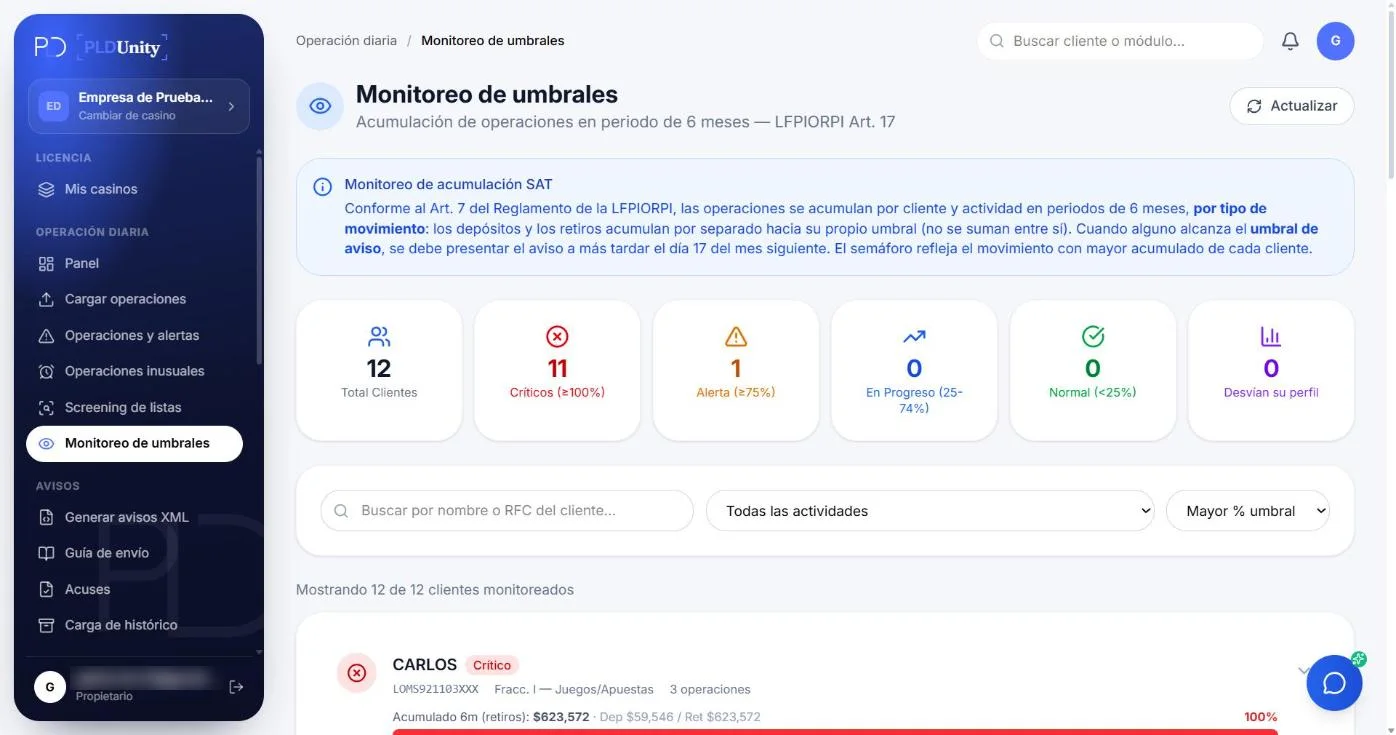
Compares each client's accumulated transactions against the identification and reporting thresholds for your activity, in the year's UMA, and warns you before the 17th.
OPERATIONAL SUITE · LFPIORPI COMPLIANCE
Every monthly compliance task, synchronized in one cockpit.
Explore how each module works interactively. Operations feed threshold tracking, screening, risk assessment and XML notices without duplicate manual entry.
Threshold Monitoring
MODULE CAPABILITIES
What it does
- 01Feature
Thresholds per activity
Each vulnerable activity uses the thresholds from the SAT's official table, in UMA.
- 02Feature
The UMA in force on each date
Peso conversion uses the UMA value in force on the transaction date; the new value applies from February 1.
- 03Feature
Monthly and semiannual accumulation
Sums per client over the periods the law sets, with the cash cap where it applies.
- 04Feature
Alerts before the 17th
What you will have to report shows up in the officer's agenda days in advance.
- 05Feature
Article 32 cash restriction enforcement
Enforces strict statutory cash bans of 8,025 UMA for real estate and 3,210 UMA for vehicles, jewelry, art, gaming, and armoring.
- 06Feature
Multi-activity separation under one RFC
Maintains independent counters and 6-month rolling windows when your legal entity operates multiple Article 17 sections.
REGULATORY & OPERATIONAL GUIDE
Compliance Guidelines for Threshold monitoring
Essential LFPIORPI obligations, identification criteria, and supervisory rules applicable to this activity.
Thresholds are set in UMA and their peso value changes every year. PLDUnity converts them for you and recalculates the totals with every upload, so you know where each client stands without opening a spreadsheet.
MODULE FREQUENTLY ASKED QUESTIONS
Frequently asked questions
How does the platform know which identification and notice thresholds apply to our activity?
The engine comes preloaded with the official Article 17 table across all 17 vulnerable activities (e.g., 325/645 UMA for gaming, 1,605 UMA for loans, 8,025 UMA for real estate & development, 3,210/6,420 UMA for vehicles, 210 UMA for virtual assets) and converts them automatically using the active 2026 UMA ($117.31 MXN).
How does it calculate the 6-month rolling accumulation required by the LFPIORPI?
For every client, the engine tracks a rolling 6-month window across all transactions that met the identification threshold. As soon as their cumulative sum reaches your activity's notice threshold, the client is automatically queued for that month's XML filing.
How does it enforce the cash and precious-metal prohibitions under Article 32?
Whenever a transaction includes cash (domestic or foreign currency) or precious metals, the engine checks the amount against your activity's strict Article 32 cap (8,025 UMA for real estate; 3,210 UMA for vehicles, jewelry, art, gaming, armoring, share transfers, and leases) and triggers an immediate alert/block if exceeded.
Does it warn our team before a client crosses the reporting threshold?
Yes. Visual progress bars and automated alerts notify your compliance team as soon as a client reaches 80% of the cumulative notice threshold—giving you time to verify that their KYC and Beneficial Owner file is 100% complete before month-end.
What if our entity operates two or more different vulnerable activities?
The monitoring engine maintains separate threshold counters and independent 6-month rolling windows for each Article 17 section active on your account.
Does the UMA value update automatically every February 1st?
Yes. Whenever INEGI publishes the new daily UMA rate taking effect on February 1st, PLDUnity updates all thresholds automatically while preserving historical UMA rates for past transactions.
30-DAY FREE TRIAL · NO CREDIT CARD
Put the Threshold monitoring module to work with your own data.
Start your 30-day free trial with your own transactions or schedule a 30-minute walkthrough with BDUnity's compliance specialists.