Real estate development
Receiving funds to develop real estate projects (2025 Reform).
Comply today with the new Section V Bis introduced by the 2025 LFPIORPI reform: mandatory identification of every investor, pre-sale buyer or trust settlor, contribution aggregation from 8,025 UMA and the 2027 EBR risk matrix.
- Legal basis
- Art. 17, section V Bis
- Identification threshold
- Always (every contribution)
- Reporting threshold
- 8,025 UMA ($941,412 MXN)
- LFPIORPI Reform (Jul 16, 2025)
- New mandatory Section V Bis

INTERACTIVE REGULATORY COCKPIT
Simulate AML Compliance for Your Industry
Calculated in real-time with official 2026 UMA ($117.31 MXN), Art. 17 notification thresholds and Art. 32 cash restrictions.
Art. 17 LFPIORPI
Identification on all operations; SAT XML report at 8,025 UMA and strict Art. 32 cash cap.
8,025 UMA ($941,412 MXN)
Identification threshold: Always (every deed/contract)
8,025 UMA ($941,412 MXN)
Exceeding this limit in cash constitutes a serious sanction under Art. 53.
Anexo 5
Cumulative 6-month threshold monitoring per client
CAPABILITIES FOR YOUR INDUSTRY
How PLDUnity helps
- 01Feature
Native support for the new Section V Bis (2025 Reform)
Since the July 16, 2025 reform, receiving third-party funds for real estate development (pre-sales, equity contributions or project debt) is a standalone vulnerable activity.
- 02Feature
Accumulation of capital calls and pre-sales per contributor
Sums every advance, capital call or pre-sale installment per investor across 6-month windows to detect when received funds cross 8,025 UMA ($941,412.75 MXN).
- 03Feature
KYC files for individual, corporate and trust investors
Collects required documents for individuals, legal entities and trusts via digital link, using AI to validate IDs and Beneficial Owner disclosures.
- 04Feature
Combined Section V + Section V Bis operation
If your developer raises construction funds first (V Bis) and later deeds the finished units (V), run both sections in one account without duplicating client files.
- 05Feature
7-source screening across the entire construction timeline
Developments span 18 to 36 months: PLDUnity screens every contributor against SAT 69-B, OFAC, UN, PEP, FBI and OFSI throughout the life of the project.
- 06Feature
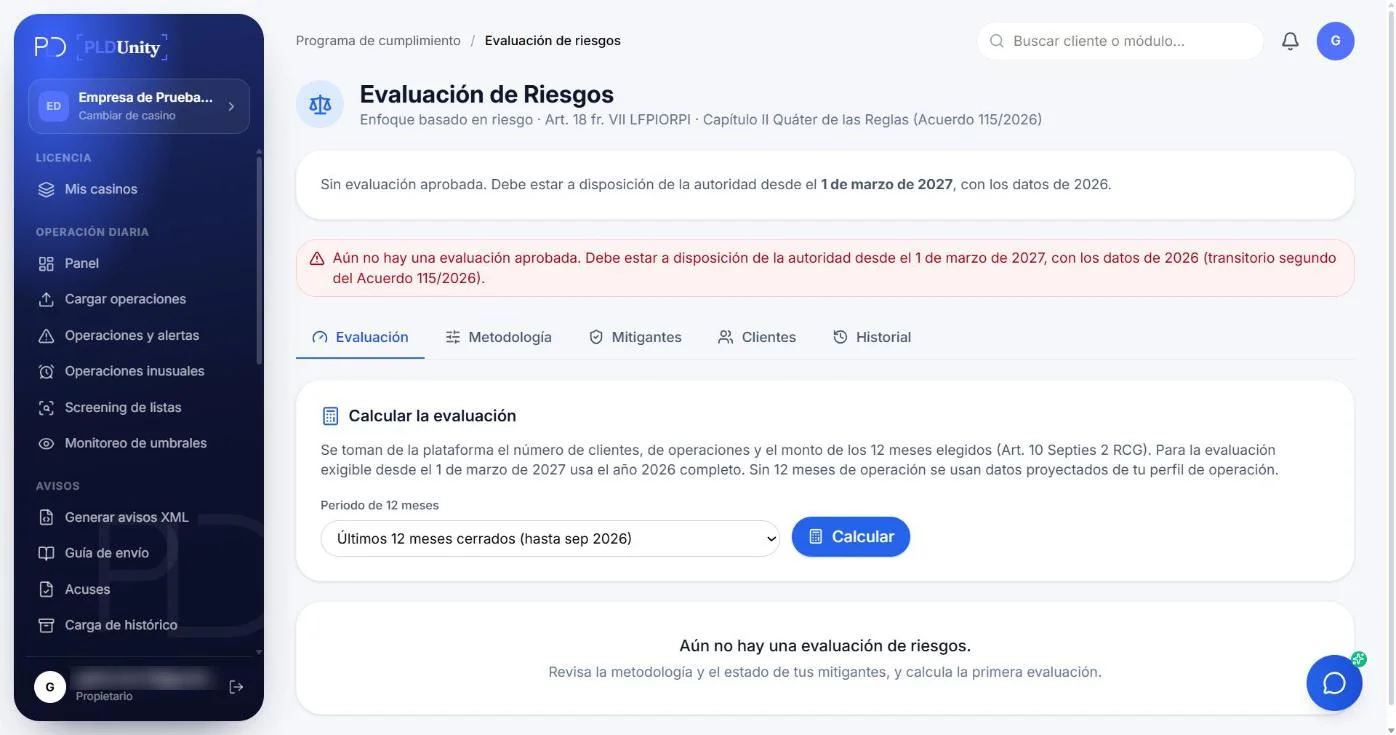
EBR risk methodology ready ahead of March 1, 2027
Recalculates each investor's risk grade monthly and generates the official SAT XSD-validated XML report with 10-year SHA-256 retention.
END-TO-END WORKFLOW
How PLDUnity runs end-to-end in your industry
A single connected workflow for capital contributions, pre-sales, advances and project funding—without re-keying data between spreadsheets and separate tools.
- 01KYC & Beneficial Owner
Identify every investor, contributor or pre-sale buyer
Identify 100% of your investors, trust settlors or pre-sale buyers from their first contribution via KYC link with AI validation of corporate deeds, powers of attorney, IDs, tax certificates and Beneficial Owners.
- 02UMA & Art. 32 Engine
Capture, aggregate & check cash caps
Record every capital call, contribution or pre-sale payment received for the project. The engine accumulates per contributor across 6-month windows and watches the 8,025 UMA ($941,412.75 MXN) threshold and cash ban.
- 037 List Sources + EBR 2027
Watchlist screening & EBR risk grade
Screen every equity partner and buyer individually or in batches against 7 watchlist sources (including SAT 69-B, Unlocated and PEP) throughout the construction cycle, updating their EBR risk score.
- 04SAT XSD + 10-Yr Vault
Validated XML report & SHA-256 evidence
Generate the official Section V Bis XML report (plus Section V if you also sell the finished units) validated against the SAT XSD before the 17th.
MEASURABLE IMPACT
Tangible value for every area of your company
PLDUnity removes friction from commercial operations while giving your Compliance Officer and Board verifiable certainty.
Raise capital and pre-sales with digital onboarding
Investors and pre-sale buyers complete their digital KYC file in minutes without paper folders, speeding up contribution and trust agreements.
From days of spreadsheet work to minutes before the 17th
The July 16, 2025 reform created Section V Bis specifically for entities receiving funds for real estate developments. PLDUnity covers both sections seamlessly.
Protection against fines up to 65,000 UMA ($7.6M MXN)
Reach March 1, 2027 with your EBR risk methodology, compliance manual and investor files audit-ready for any SAT or UIF inspection.
WHY CHOOSE PLDUNITY
The PLDUnity differentiator
Built in Mexico by BDUnity®, an AML compliance consultancy advising reporting entities since 2012.
Tailored to your exact Article 17 fraction
Built from day one for the July 16, 2025 LFPIORPI reform: covers Section V Bis, expanded Beneficial Owner rules and the 2027 EBR methodology.
Software with real consultants behind it
Created by BDUnity® (active since 2012). Every validation rule, annex checklist and audit package reflects real SAT inspections—not generic template software.
AI that accelerates, an Officer who decides
AI reads IDs, tax certificates and custom Excel columns in seconds, but every critical match, risk methodology and XML filing is confirmed by your Compliance Officer.
Google Cloud isolation & SHA-256 fingerprints
Each company runs isolated with TOTP 2FA, role-based segregation of duties, a server-only audit log and SHA-256 hashes on every XML, acknowledgment and 10-year export.
BEFORE & AFTER
Manual spreadsheets vs. PLDUnity in your industry
Why reporting entities replace disconnected folders and generic tools with a purpose-built LFPIORPI platform.
| Compliance dimension | Spreadsheets & disconnected tools | With PLDUnity® in your industry |
|---|---|---|
| 6-month UMA aggregation & thresholds | Assuming that receiving construction contributions (before deeding a sale) was exempt from identification and reporting under the new Section V Bis. | Dedicated Section V Bis tracking under the 2025 reform: always identify the contributor and report once received funds reach 8,025 UMA. |
| Client KYC & watchlist screening | Developers that both fund the project (V Bis) and sell finished units (V) managing two disconnected compliance trackers. | Both activities (Sections V and V Bis) configured in the same company, sharing the client's KYC vault without asking for documents twice. |
| Monthly SAT XML preparation | Manual XML capture prone to schema errors, malformed RFCs/CURPs and last-minute rejections on the 17th. | Pre-validated against the official SAT XSD schema for your activity, plus one-click nil reports and linked acknowledgments. |
| 2027 Risk-Based Assessment (EBR) | Static Word document without individual client risk recalculation or historical audit trail. | Four-factor EBR engine with capped mitigants that recalculates every client's risk grade on the 2nd of each month. |
| SAT / UIF inspection readiness | Weeks spent gathering scattered PDFs, emails and acknowledgments across former employees' computers. | One-click audit package with server-written logs, SHA-256 integrity hashes and expiring read-only access for external auditors. |
ALL-IN-ONE PLATFORM
All 8 platform modules working together for Real estate development
Your subscription includes the complete AML compliance suite—no hidden add-ons per module.
Transaction Upload (Excel, AI & API)
Validate every record against SAT catalogs with idempotency and 6-month accumulation.
UMA Threshold Monitoring
Automatic tracking of identification, reporting and Art. 32 cash caps in current UMA.
Digital Customer Files & Remote KYC
Remote link or QR with AI document reading (OCR), AI-assisted face match, and liveness test.
7-Source Watchlist Screening
UN, OFAC (SDN & consolidated), UK (OFSI), FBI, SAT 69-B, Non-Located & PEP queried per client, in batches, or manually.
2027 Risk-Based Assessment (EBR)
Four-factor risk methodology and per-client risk grade recalculated every month.
24-Hour Unusual Transactions
Automated case clock, red-flag analysis and documented Compliance Officer decisions.
SAT XML Generator (19 XSDs)
Pre-validated XML for your exact Article 17 fraction, one-click nil reports and acknowledgments.
10-Year SHA-256 Audit & Training
Immutable server log, 16-obligation self-assessment, AML courses and portable audit packages.
REGULATORY & OPERATIONAL GUIDE
Compliance Guidelines for Real estate development
Essential LFPIORPI obligations, identification criteria, and supervisory rules applicable to this activity.
What changed with Section V Bis in the July 16, 2025 LFPIORPI reform
Prior to the reform published in Mexico's Official Gazette (DOF) on July 16, 2025, developers receiving funds through contribution agreements, pre-sales or trusts prior to formal deed execution faced regulatory ambiguity. The new Section V Bis makes any receipt of funds intended for real estate development (for subsequent sale or lease) a vulnerable activity in its own right.
Client identification applies always from the first peso received, and an XML report must be filed with the SAT whenever funds received in a single act or accumulated over 6 months reach or exceed 8,025 UMA ($941,412.75 MXN at 2026 UMA).
Track capital contributions, pre-sales and final deeds in a single client file
In PLDUnity you onboard each investor or pre-sale buyer via a digital link. Their installments accumulate automatically per project, their profile is screened against 7 watchlist sources and, when construction finishes and units are deeded, the exact same KYC file serves Section V without asking the client for documents twice.
FREQUENTLY ASKED QUESTIONS
Frequently asked questions
When did Section V Bis take effect and what are the 2027 deadlines?
The reform was published in the DOF on July 16, 2025 and entered into force the next day. Transitional deadlines for the Risk-Based Assessment (EBR) methodology and updated compliance manual fall on March 1, 2027.
If we collect pre-sale advances and later sell the finished condo, do both sections apply?
Receiving funds to develop the project falls under Section V Bis and deeding the finished property under Section V. PLDUnity lets you configure both in the same company while sharing the client's KYC vault.
How are corporate investors or investment vehicles handled?
The KYC module collects incorporation deeds, powers of attorney, tax certificates and representative IDs while documenting the Beneficial Owner under the reform's expanded criteria.
What if no contributor crosses 8,025 UMA in a given month?
File a one-click nil report from the platform before the 17th and store the SAT acknowledgment in the vault with its SHA-256 integrity hash.
What does the 8,025 UMA threshold equal in MXN for 2026 in Real Estate Development?
With the 2026 daily UMA of $117.31 MXN, the 8,025 UMA notice threshold under Section V Bis equals $941,412.75 MXN (either in a single capital contribution or accumulated across a rolling 6-month window per investor or pre-sale buyer). Full KYC identification is mandatory from the very first peso.
How is the Article 32 cash restriction enforced across pre-sale installments and capital contributions?
Whenever a down payment, installment, or equity contribution is logged, PLDUnity validates the payment instrument and blocks any cash acceptance reaching the 8,025 UMA cap ($941,412.75 MXN in 2026), archiving wire transfer proofs inside the investor's KYC dossier.
Can we segment multiple projects, towers, or development trusts within our account?
Yes. You can organize operations by project, tower, or SPV/trust while automatically consolidating the 6-month rolling accumulation whenever the same investor funds multiple units under the same RFC.
30-DAY FREE TRIAL · NO CREDIT CARD
Ready to automate AML compliance for Real estate development?
Start your 30-day free trial with your own transactions or schedule a 30-minute walkthrough with BDUnity's compliance specialists.